Perfect baby sleep can be the great white whale of parenting. We went into parenting not knowing anything about baby sleep besides the rule to lay baby down on their back. Now I’ve got a year of experience under my belt. I’m going to let you know what I did and what worked for us. I’m no expert and this will not work for everyone, but I’m happy with Calvin’s sleep.

The only thing that I knew about baby sleep before I had a baby was that they woke up often at night to eat. I knew nothing about sleep schedules, wake windows, swaddling, pacifiers, sleep cues, bedtime routines, white noise, developmental leaps, sleep regressions, or the fact that an “infant sleep consultant” was an actual profession.
Now, I do feel the need to preface this blog post by saying that Calvin likes to sleep. He always has. His preference for sleep over eating as a newborn was actually a substantial source of stress. He still went through sleep regressions and had middle-of-the-night feedings, but we have not had to overcome some of the hurdles that other parents have had to.
Calvin is now one year old and his sleep schedule has been consistent for the last several months. I am expecting him to need an adjustment in the near future, but for now, this is working. I think the main things to remember when it comes to infant and early childhood sleep are that it is continually changing and evolving and every child is different.

BIRTH TO FOUR MONTHS
For the first four months of Calvin’s life, I had no plan. I had no method. And I was so concerned with his eating habits and his weight, that I didn’t have any worry left in me to allocate to his sleep. All of that aside, the first few months are really controlled by the baby in pretty much every household. They and their hungry bellies dictate when to eat and when to sleep.
Day vs. Night
The first hurdle that we really notices was that Calvin’s internal clock was completely reversed. He would happily sleep for hours at a time all throughout the day, but as soon as the sun when down, he was ready to be awake and playing. This is really common in brand new babies. When they are in the womb, they spend most of the day sleeping, because the motion of their pregnant momma moving around lulls them to sleep. Once mom lays down to sleep, however, the lack of motion wakes baby up. Moms often notice that babies get really active right as they are laying down to sleep, and strong kicks can wake them up at night.
To teach Calvin the difference between night and day, we let Calvin sleep whenever he wanted to (we didn’t worry about wake windows or keeping him awake during the day) but we did create distinct day and night sleep environments. During the day, the lights were left on, noise (family members, television, visitors, etc.) wasn’t quieted at all, and we didn’t ususally use a white noise machine. During the night, whether Calvin was asleep or not, we kept the lights dim or off, had a white noise machine running, and kept other noise to a minimum. Eventually, Calvin learned that dark was night and meant longer sleep, and light was day and meant nap sleep.
Sleep Cues
When I was pregnant, I read the book The Happiest Baby on the Block by Dr. Harvey Karp and I highly recommend it. He gives step by step instructions about how to utilize the 5 S’s to calm your newborn and help them to sleep and they are absolute witchcraft. I was shocked by how magically these techniques worked for my little baby. I’ll give you a brief overview of the 5 S’s, but I still strongly recommend that you read Dr. Karp’s book. It’s amazing.
- Shushing – did you know that a womb is as loud as a vacuum cleaner to babies living inside of it? All of the bodily functions and blood rushing around makes for a loud place to grow. A white noise machine brings baby right back to momma’s belly. We loved both our Hushh and Letsfit portable white noise machines.
- Swaddling – babies are born with a “startle reflex” that can disturb their sleep. They also have just come from a very warm and very compact environment, so this bright and big world is jarring. Swaddling your baby helps them to feel safe, secure, and prevents their arms from flying up and scaring them awake. Calvin loved to be swaddling from Day 1.
- Swinging – remember how babies’ days and nights are all confused because momma’s daytime movement lulled them to sleep? This is why rocking, swinging, and bouncing is very comforting to young babies. Calvin’s favorite method was a tiny, very quick bouncing movement. When combined with his swaddle and pacifier, this was a sure way to get him down for a nap during the day.
- Sucking – this usually means a pacifier or a thumb. This “S” is usually the last one to offer and doesn’t work for all babies. Calvin happens to love his paci, so sucking was a huge soothing help for us.
- Side/Stomach – this doesn’t refer to laying baby in their bassinet on their side or their stomach for sleep. This is not considered safe. This “S” refers to holding your baby on their side or face down while you rock them. This position can be reminiscent of the womb and can sooth your baby.
For Calvin’s nighttime sleep, I used swaddling, shushing (white noise machine), and sucking to help him to settle himself to sleep. For his naps, we typically omitted the white noise machine and would just swaddle him, give him his pacifier, and rock him to sleep. Once he was asleep, I would either hold him for his nap or I would place him in his lounger on the couch right next to me for his nap. I also used to take a blanket and roll it up to create a gentle “hugging” feeling when Calvin would sleep on the floor.
Schedule and Routine
Calvin had no sleeping schedule, only an eating schedule for the first several months of his life. He was eating every two hours, so the quicker he ate, the longer he could sleep before the next feeding. I would watch for his “sleepy cues”, which for Calvin meant he would get really talkative and then, if I didn’t lay him down in time, really cranky. When I saw his cues, I would swaddle him, give him a pacifier, and he would be asleep within minutes.
Calvin would wake up for the day between 9-10 in the morning, he would take several naps during the day (his last one being around 8:00 pm) his last feeding would be around eleven o’clock at night, down to bed at midnight, feed at 3:00 and 6:00 in the morning, and back up between 9:00 and 10:00. It was very unorthodox, but it worked for us and that’s all that mattered at the time.
THE FOUR MONTH SLEEP REGRESSION AND SWADDLE TRANSITION
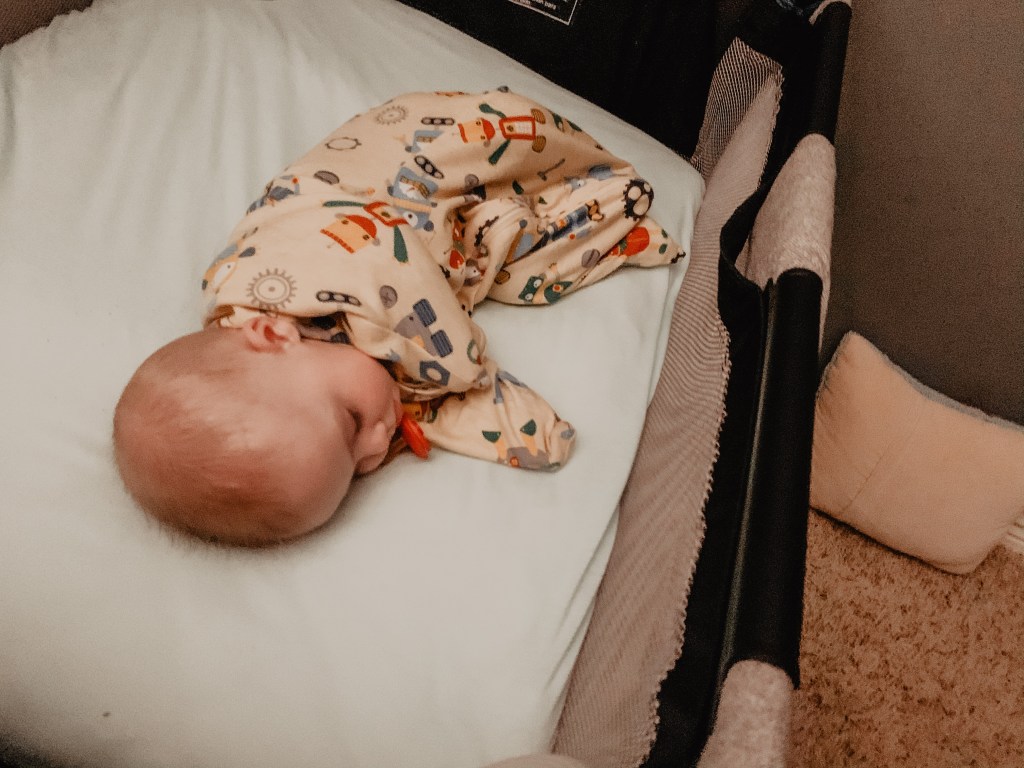
The four month sleep regression occurs because of a huge development in your baby’s brain and a total change in how his or her brain utilizes sleep. When Calvin started going through it, he would wake up every 90 minutes all night long. It was difficult because he was fully on formula by then, so I knew that he was getting all of the food that he needed during the day, so feeding him back to sleep didn’t feel like a good option for us. I was also starting to get the vibe that his swaddle was contributing to his sleep disturbance.
The Zipadee-Zip
When I first started trying to transition Calvin out of his swaddle, I used the shoulder snaps on his Sleepea swaddle to allow him to sleep with one arm free and one arm swaddled down. (Also good to note, Calvin was still sleeping in the Pack N’ Play next to our bed at this point). The first night, Calvin whacked and scratched himself in the face all night long. The whacking didn’t bother him, but his fingernails did, so I used his fold-over mittens from that night on. After a week or so, I allowed both of his arms out, with the swaddle strap still wrapped around his torso and it worked fairly well. However, when I tried to move him to a sleep sack, he suddenly wouldn’t sleep well.
That’s when I discovered the Zipadee-Zip. This is a Shark Tank product that was designed for swaddle transition. The idea is that your baby retains enough mobility to replace their own pacifier or push up to move their face if they roll over to their stomach. But they have enough of a boundary to create a feeling of security. It also keeps their hands covered, warm, and their face protected from their fingernails.
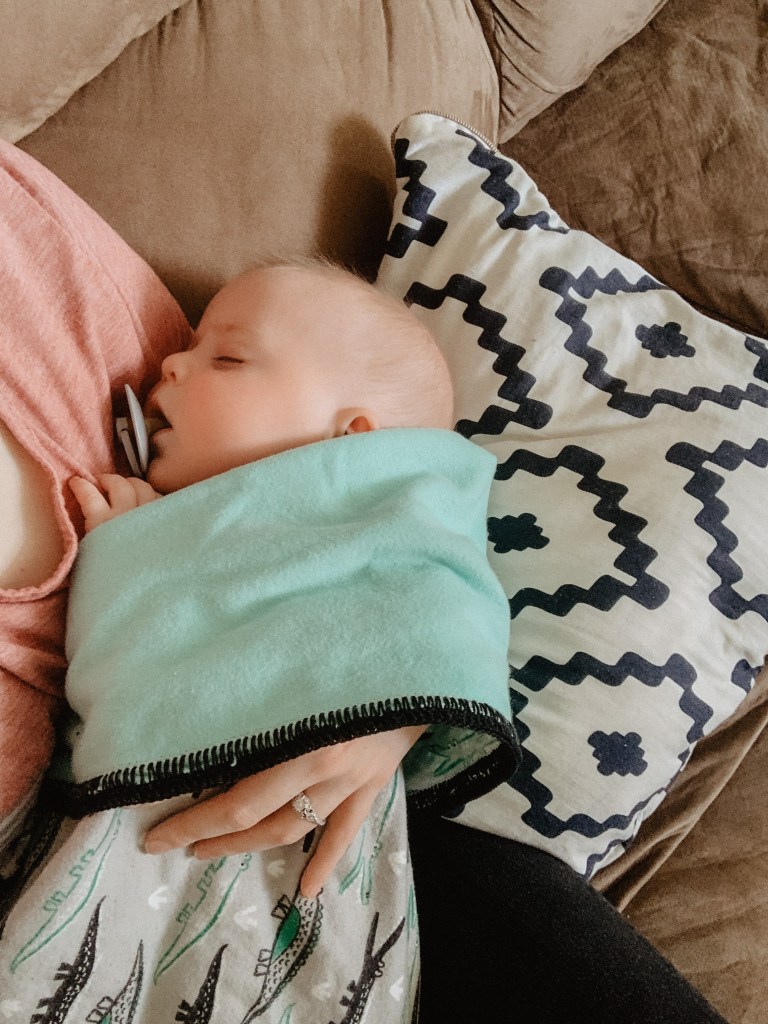
This product worked amazingly for Calvin. It became his new sleep cue. As soon as I would zip him into this sleep sack and give him his pacifier, he would roll around in his bed and go to sleep within minutes. Even in bright daylight on a houseboat in Lake Powell.
SLEEP TRAINING (6-8 MONTHS)
We sleep trained and transitioned Calvin to a crib in his own room when he was roughly six months old. He was a quiet sleeper, so having him in my room until then didn’t bother me.
Drowsy, but Awake
This was the main thing that I focused on with Calvin’s sleep. Having a very quick routine that let him know that sleep was coming very soon, but also laying him down in his crib awake and letting him fall asleep on his own.
In the beginning, this meant helping Calvin fall nearly to sleep in my arms without his pacifier, then laying him down in his crib, and softening the transition with his pacifier. Once he was doing this reliably, we would just do the bedtime routine and lay him down without rocking and giving him his pacifier.
Wake Windows
If you have never heard of a “wake window” I highly recommend that you Google them. Basically, a wake window is roughly how long your child should be awake from the time they wake up to the time they are laid down for their next sleep, based on their age. Taking Cara Babies has a great Instagram post that gives rough guidelines for age-appropriate wake windows.
Wake windows were the main guide that I used to time Calvin’s naps and help him to consolidate his nighttime sleep into one twelve hour stretch. Having enough wake time and not too much napping during the day helped Calvin to be tired enough to sleep all night through.

8 TO 13 MONTHS
The wake window recommendation I found for an 8 month old is roughly 3-4 hours. With Calvin sleeping from 8:00 pm to 8:00 am, I figured that a nap from 11:00 am to 1:00 pm and from 4:00 pm to 5:00 pm would work out perfectly for three hour wake windows. I started transitioning him to this schedule gradually, and in about a week, he was there.
At this point (12 months old) this is how bedtime goes for Calvin:
- Go to his bedroom with a bottle of whole milk
- Lay him on the floor and change his diaper while he drinks his milk. Put his footie pajamas on and zip him into his sleep sack.
- Wait for him to finish his bottle of milk
- Set him on my lap and say a quick, quiet prayer with him.
- Turn his white noise machine on (he has blackout curtains also), turn out the light, lay him in his crib on his back, hand him is pacifier (he puts it in his mouth himself), say “Goodnight Calvin. I love you. I’ll see you tomorrow,” and leave the room, closing the door behind me.
For naps, it’s almost identical, just without the pajamas and the prayer. At this point, putting Calvin down to sleep takes about 5 minutes for naps and 15 minutes for bedtime. It’s awesome. He usually babbles to himself for a few minutes and then goes to sleep. He sleeps for 12 hours at night, and I only have to go in if his pacifier falls through the crib bars to the floor and he wakes up in the night and can’t find it. I’ll start to wean him off of the pacifier around 15 months (he currently only uses it for sleep) and I hope to eliminate it by 18 months.
Calvin’s sleep schedule is 98% reliable and predictable because I’m sure that he would take longer than 2 and 1 hour naps if I let him. I almost always have to wake him up in the morning and from both naps.
Some people’s jaws drop when they hear that I wake my baby up from his night sleep and from his naps. They can’t understand why on earth I would wake my child up when he is sleeping so soundly. The answer is, I do it because it’s what is best for my kid. If I didn’t wake him to keep him to his schedule, his bedtime would get pushed later and later and he would become over tired very quickly.
This doesn’t mean that I am rigid and unbending in his schedule. We absolutely have weird days, appointments that get in the way, and his schedule goes out the window when we are on vacation. However, I know that no matter how poorly the day went, his sleep habits are solid and reliable. It works so well, and when he starts to reject his second nap (somewhere between 13 and 18 months), I’ll move him to a single nap from 12:00 pm to 3:00 pm each day. This will give him a four hour wake window in the morning and a five hour wake window in the afternoon, which will be appropriate for his age and development at that point.

Well, there you have it. This whole methodology worked for Calvin and I can all but guarantee that it will not work the same way for our future kids. But if anything I said reminds you of your child, give my experience a try!


 BARREL OF MERRELL'S
Leave a comment