Just about two years ago, I created my very own sourdough starter from scratch. Read on for the simple method I used with great success!

About two years ago, I was six months postpartum and honestly wanting to find more ways to feel like a ”homemaker” despite working part-time outside of my home. I had also recently had this desire for a very ”home-based” lifestyle awakened in me. I began researching gardening, raising chickens, details of a milk cow, homeschooling, canning, and many other homemaker skills that I don’t have. Most of the subjects I was looking into, like chickens and cow\\, weren’t an option because we are renters of a basement apartment. But the one thing that stuck out to me as being totally feasible in my life was learning to bake with a sourdough starter.
I considered asking on my local facebook page if anyone had a starter that they would be willing to share with me or finding a dehydrated one online that I could revive and bake with. But I have a streak in me that takes a lot of pride in doing things myself. So I began reading about creating my own sourdough starter and found it to be well within my abilities. And thus, Mabel was born.
Mabel is just what I decided to name my starter. I first started her in the summer of 2020. I mostly used her for discard recipes and a few failed baking attempts (failure due to my lack of knowledge, not due to the quality of my starter). Then, when I was about 7 weeks pregnant with Della in the spring of 2021, I found that I could not stand the smell of my starter without becoming really nauseous. And so Mabel went in the fridge until Della was about 6 months old. I pulled her out, revived her with a little flour, water, and TLC and now I am using her for all sorts of things, from artisan bread to crispy pizza crust to homemade pretzels.
Alright, now that you’ve read Mabel’s origin story, here’s how I started her in the first place.
THE SUPPLIES
First, find yourself two glass quart jars and two loose fitting lids. You want the lids to be loose fitting so that they trap moisture inside the jars, but allow gases produced by the yeast to escape.
Next, obtain unbleached all-purpose flour and flitered/distilled water. You want these two specific things because you are trying to trap and cultivate the natural yeasts in your environment to create the starter. If you use flour that has been bleached or tap water with trace amounts of chlorine or fluoride in it, you are creating a very difficult environment for your yeasts to grow in.
Last, buy yourself a cheap kitchen scale like this one that measures in grams and has a tare function. I find that weighing my starter, flour, and water amounts to be the easiest way to manage feedings.
THE METHOD
Your goal in “making” a sourdough starter is to capture the wild yeasts in your environment and to cultivate them in a mixture of flour and water that you can then use in baking. When I started Mabel, it took about 7 days. If you are trying to begin your starter in the winter, it may take a little longer due to the cooler temperatures.
DAY 1
Start with a clean glass jar. I find using one that will hold at least 32 ounces of liquid to be best.
For this very first mixture of flour and water, I used regular measuring cups instead of my scale. I recommend starting with about a 1/2 cup of unbleached flour and about a 1/2 cup of filtered water. Mix these two components together until they are totally combined.
Cover your jar with a loose fitting lid. You want to keep the majority of the moisture contained in the jar, but allow air to escape as necessary. Set your jar in a warm, dark area and leave it for 24 hours.
DAYS 2-5
Get yourself a second clean glass quart jar and your kitchen scale.
Measure out 30 grams of the mixture from the previous day into the clean jar and throw the rest away.
Note: even though this leftover mixture is technically “discard” don’t bother saving it or trying to use it in a discard recipe. Just throw it away. Once your starter is established you can find ways to use your discard if you’d like. Also, I strongly recommend against putting your discard down the sink. Once dried, it is very tough to remove, so add it to your compost or just throw it away.
Add 125 grams of filtered water to the 30 grams of starter in your jar. Mix until the mixture is milky looking. I find that the handle of a wooden spoon works well for mixing.
Add 140 grams of unbleached flour to the jar and stir until completely combined. You can use a silicone spatula if you’d like to scrape the sides of the jar.
Cover your jar with a loose fitting lid and set in a warm dark area to rest for 24 hours.
DAYS 6+
Starting at about Day 6, you will continue to discard and feed your starter as you have been for the last 5 days, but rather than letting the starter rest for 24 hours in between feedings, shorten the rest time to 12 hours (i.e. feed morning and night).
HOW TO KNOW WHEN YOU ARE READY TO BAKE
You’ll know that your starter is ready for use in baking when you can observe a couple of signs:
- You can see bubbles forming in your starter in the hours after a feeding. They will be visible on the bottom, sides, and top of the starter.
- Over the course of about 24 hours after feeding, your starter will grow to about 3-4x the height that it was immediately following the feeding and then it will gradually fall back down to its original height.
TIMING YOUR FEEDINGS WITH YOUR BAKING
When looking at sourdough recipes, you’ll see that they call for one of two things. Either you need “active starter” or you need “starter discard”.
To bake a recipe that requires “active starter” you’ll want to feed your starter about 6-12 hours before you want to start baking. This give your sourdough yeasts time to wake up and be actively converting flour into gas, which is exactly what you want for fluffy bread. You’ll know your starter is ready to start baking with when it’s 2-4x the height it was when it was fed.
To bake a recipe that requires “starter discard” you’ll want to use starter that was fed 24+ hours ago and has fallen back down to its original height. These recipes usually want to incorporate the sourdough flavor, but don’t need to rise (i.e. pancakes).
If you feed your starter and don’t bake with it during its “peak”, you’ll either need to use the discard in a recipe or throw it away. If you just feed it again without discarding, you’ll end up with tons of starter to use up.
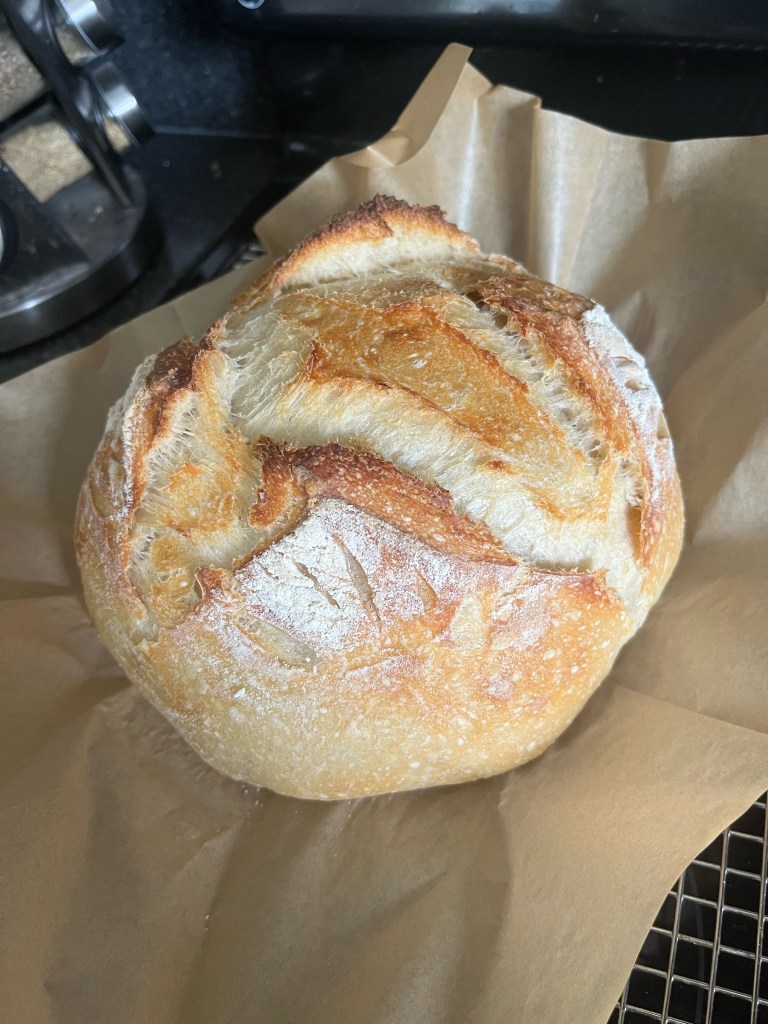
I hope this was helpful and not “clear as mud” as my Grammy would say. If you have any questions please feel free to reach out via email or over on Instagram. I also have several highlights on my IG page about sourdough that may be helpful.


 BARREL OF MERRELL'S
Leave a comment